Monday, December 5, 2011

Fly Fishing the Middle Provo River

I first hit the lower Provo River.  This is a river I used to frequent often.  In fact, I have fished every section of the lower Provo from the mouth of the canyon to the Deer Creek Dam.  I was quite disheartened on this trip.  Walking down the railroad tracks I noticed a lot of the trees and shrubs between the river and the tracks had been bulldozed.  Private property signs were all over the place.  This is not the same river I had been used to.  Since I was there I gave it a try.  I fished my favorite stretches that always produce in the fall.  The water was somewhat off color, not the usual low clear water that is typical in the fall.  I didn’t even get a strike.  I tried a couple different sets of flies - those that, from experience, always work in the fall on the Lower Provo.  I gave up after a couple of hours and decided to try somewhere I have never fished before, the Middle Provo River.

The Middle Provo is the stretch that is between Deer Creek Reservoir and Jordanelle Reservoir.  This section, historically, had been straightened, dewatered and utilized for irrigation.  A few years back, it was reconstructed to its original course.  This is now the stretch of river which is most recommended in the state.  It is also known as always being crowded. 

There are official paved parking lots with outhouses and signs.  I pulled into the parking lot and there were eight other cars.  The parking lot on the other side of the road and a few hundred yards down had just as many.  This was in the middle of the week, not the weekend.  I hiked along the river, passing several fishermen.  I asked if the trail went far.  The fisherman I asked said that he thought it went the entire length of the river. 

I figured the further away from the parking lot, the better.  Sure enough, I kept hiking and never found the end of the trail.  In fact I crossed the river and the trail on the other side kept going as well.  This river definitely has easy access.  In the stretch I hiked I found three guides each with two or three clients. 

I started fishing and quickly caught a small brown trout.  A few minutes later I caught a slightly larger one – not bad for a first time visit.  These fish I caught on the usual small nymphs I use for the Lower Provo and Weber rivers, Pheasant Tails, etc.  I would have liked to have had my 4 weight rod and been dry fly fishing.  I did see quite a few fish jump.  This part of the river is smaller than the Lower Provo and Weber and would have been easy to fish with a dry fly.  The hike along the trail is pretty.  They have done a good job making the river natural with plenty of trees and shrubs. 

In fact, there are even bird houses in the trees here.  I will definitely come back and try this river again.
By the way, I traveled up and down the river for miles and never did find that black bear.

Friday, November 11, 2011

Wolf Flat Camp

Friday we only had 8 miles to float to our destination, the Wolf Flat camp.  There is also a boat ramp at Wolf Flat.  I looked at the map to see if this would work as a takeout spot but this would be a long drive for a shuttle to get to the nearest bridge to cross the river and then to get to the ramp. 

The day started out calm, bright and clear.  Looking around the camp it looked like the skunk hadn’t done any damage.  We floated around the next bend in the river were the river forked.  Where the two forks came back together there was some deep, slack water next to fast water flowing by. 

Using Pale Morning Dun dry flies again, we cast right next to the fast water and ended up catching ten or so cutthroats. 

These weren’t big fish but they were sure fun to catch and it was a nice way to start the day.

Another fun spot was a mile or so down the river across from a cabin.  Again there was some deep water right where another fork entered the main river.  This is where we had lunch.  By now we had finished all our yummy pastrami, roast beef and cheese sandwiches and only had peanut butter and honey sandwiches left.  I fished downstream where there was turbulence caused by the other fork while Nick fished upstream where the river became deep and fast.  I didn’t even get a bite.  Meanwhile Nick had a strike from a large trout and he kept fishing in the same spot, hoping it would strike again or if one big trout likes a certain spot, chances are another one will too.

There are a few cliffs along this stretch.  Each time we would pass another section near cliffs it would seem like déjà vu because they all look the same.  We kept taking turns rowing and fishing.  We kept catching a few here and there. 

We were fortunate in seeing another moose and another golden eagle. 

As the day wore on, the wind kept picking up. 

By the time we got near the camp spot at mid-afternoon, the wind was really making it difficult to cast.  We kept our eyes open for the Wolf Flat ramp or camp spot.  We even stopped were we thought it should be. 

I walked back along the shore to ask another couple of fisherman if that was the camp.  They said Wolf Flat was still around the next bend.  Around the next bend there was still no ramp.  Nick and I discussed our options.  By this point it was too windy to fish and didn’t show any signs of letting up.

We decided to just row the additional four miles to our takeout point at Byington Poplar since we weren’t going to be fishing the next day anyway.  We would be in a hurry to get home for the party celebrating Porter’s, Brooke’s, Janessa’s and Nick’s birthday’s which all occur during the month of October.

I started rowing hard toward our destination.  It felt like I was rowing uphill against the wind.  Nick then volunteered to row.  We did pass a couple other campgrounds through this section that we were unaware of.  These were called Rattlesnake Point and Clark Hill.  If we hadn’t decided to just go home for the night these would have worked out well.  In fact, I marked these sites on my map and we will keep them in mind for future trips.

At the take out at Byington, there is a metal box where you can place your rainbow trout heads to participate in an incentive program.  The aim of this program is to reduce the number of rainbow trout in the river.  The cutthroat trout are the native trout of the river.  The rainbows compete with them and also breed with them, diluting the gene pool. 

After a long day of rowing, 12 miles, Nick and I were anxious to hit the Golden Corral again.  We ended up getting home at 1:00 in the morning.  In the end, it was a good thing we came home Friday night.  This gave us time to unpack, do laundry and put everything away before the party.  It also gave Nick time to get packed and head for the airport at 5:30 Sunday morning.  Unloading the cooler in the morning we were pleased to find that there were still big chunks of ice left and that the milk was nice and cold.

What was my favorite part of the trip?  The first thing that comes to mind is Nick having so much success with dry flies that he tied himself.  The biggest trout of the trip were caught on Nick’s dry flies.

Saturday, November 5, 2011

Lufkin Bottom - Day 3

Thursday we only had five miles to float to our camp spot called Lufkin Bottom.  This stretch of water has some good cliffs, islands, gravel bars and deep holes.  We took our time at each stop. 


Around the first bend in the river we were met by two eagles sitting on a branch next to each other. The weather was perfect with little wind. We stopped on the other side of the river were it braided near some cliffs. 

We caught a few white fish here but not the numbers of trout we were hoping for.  I tried my luck with big streamers and had one hit with a rust colored Dungeon (the type my wife wears as earrings) but that was it. 

While fishing, Nick discovered a moose nearby.  This was a good start for the day.

Right after pushing off again, through the stretch we had just fished, Nick quickly caught another whitefish and then a nice cutthroat.

Nick tied on another dry fly, and he caught the fish we were after – a big brown. 

Catching a brown of this size on a dry just adds another level of excitement. 

Try it again.  Sure enough, Nick caught another good brown. 

Not as big as the previous one, but still good size.  Nick continued to catch a few more. 

Maybe it’s his turn to row now.  Just kidding, I think I caught a little cutthroat somewhere in there.

The Lufkin Bottom camp was just past another Eagle Reserve.  This seemed to be the most used camp of any we had camped in.  This is also the camp were we had a sandwich-stealing raccoon visit us last time we were there.  This time we made sure all containers were secure and even placed the totes on top of the cooler. 
Nick and I woke up the same exact instant to a sound right outside the tent.  I grabbed my camera, certain to get pictures of the raccoon this time.  I shined my flashlight out the tent’s mesh window.  It wasn’t a raccoon.  It was a skunk!  I took a picture but the reflection of the flash on the mesh made it so nothing could be seen. 

The skunk, seeing all the lights, quickly scampered back into the woods.  Thankfully never to be heard of again.  He knew we had a clean, secure camp. 

Now Andrew, Nick’s son who love’s animals can say “guess what, dad saw a beaver, a bald eagle, a golden eagle, a moose and a skunk!” Oh yeah, I also caught a garter snake earlier in the day.  I love wildlife too.  I think that’s a major part of fishing, all the wildlife you see.

Wednesday, November 2, 2011

Nick's Blue Winged Olives - Day 2

There was frost in the morning and the water still on the tent was frozen.  The water in the boat, however, was not frozen.  I was hoping we could just pick it up as ice and throw it out of the boat.  Instead we used one of our buckets to bail the water. 

As the first couple of fishermen floated by through the fog, one yelled out “the fish are still asleep, don’t worry about hurrying onto the water. “  It reminded me of Pirates of the Caribbean, boats floating by in the fog. 

As the sun came over the mountains it burned away the fog.  The cows started mooing and we could see them on the other side of the river.  They all seemed to start mooing at the sight of the sun. 

We sat our wading boots in the sun to thaw out. 
We only had 6 or 7 miles to float to our next camp site so it left plenty of time for fishing.  We pulled over at every good looking gravel bar or feature of the river. 

By the end of the second day float, we had each caught cutthroats, rainbows, browns and tons of white fish. 

Up until now we were using stone fly nymphs that we had so much success with on previous trips.


Nick noticed fish rising near the shore in front of the eagle preserve and started using a Blue Winged Olive dry fly.  He started catching quite a few cutthroat and even caught a large brown. 

These were caught on flies he tied himself and he gave me one to use.  Further attempts with a dry proved successful.  This tipped the scale to finally catching more trout than white fish.   Also, dry fly fishing is “real” fly fishing.  When dry fly fishing is successful, this is the way to fish.  Dry fly fishing is very visual.  You get to see the fish rise and take the fly.  If you miss the strike, it is still fun to see the rise.


Our next camp site, Dry Canyon #3, was just past the eagle preserve.  Again we set up the tent to dry.  There was still daylight to burn so we fished some more.  In front of the camp site there was a deep hole. 

The trout thus far were all medium-sized so I put on a streamer to try for one a little more substantial.  I caught an even smaller trout at this attempt.  Nick caught quite a few more trout before it started getting dark and was time to start warming up supper. 

We traded sleeping bags every night.  The Cabela’s Alaskan Guide sleeping bag was rectangular and therefore more roomy and comfortable.  It is rated 0 degrees.  It did take longer for feet to get warm and each time you repositioned yourself your feet would feel cold again.  The North Face Dark Star sleeping bag is mummy style and my feet were warm immediately. 

Wednesday, October 26, 2011

37 Miles on the South Fork of the Snake – Day 1

I asked Nick what his favorite part of the trip was.  He jokingly replied, “Stopping at Golden Corral on the way”.  Yes, this was a great way to start the week-long trip, stopping at an all you can eat buffet before having camp food for every meal.  No, we didn’t stop at the 7-11 for candy.

Since we were floating five days rather than three, we decided to start the float a little higher on the river rather than the usual put-in at Conant.  Checking at the fly shop we found out that Irwin did not have a good ramp and was real steep.  They steered us toward the Palisade Creek put-in which does have a nice cement ramp.  This was fortuitous because there is also a campground and a service station (Huskey’s) there.  Since we were camping after September 30th, which is the end of the official camping season, we did not have to pay for camping for or pay the daily parking “recreational’ fee for the week.  We still filled out an Overnight Camping Permit.

Since it was still daylight after we pitched the tent, we disconnected the boat and drove up to see the dam.  We were curious to see how much water was being released.  Just that week they had lowered the amount of water released to 6,000 cfs as opposed to the 8,000 to 10,000 cfs that were being released all summer.

It started to rain as we headed back to the campground.  We were glad the tent was up.  We lit the propane stove and started to warm two cans of stew.

We could see eagle’s nests across the river.  It ended up raining lightly all night and most of the next day.  Luckily it wasn’t too cold. 

In the morning, after loading the boat, we placed a tarp over the very back of the boat to cover the items not in the tote boxes, like the sleeping bags and pads.

We floated 12.5 miles on this rainy Tuesday. 

Despite the rain, we saw over a half dozen eagles. 

Also of note was that we floated past the river side of the South Fork Lodge, the side you see in their literature. 

Then shortly thereafter we floated past the Conant valley ramp where we usually start our float trips.  Our Second day camp is just one mile past this ramp.  The camp is called Pine Creek #1. 

Nick caught quite a few fish that evening after setting up the tent before having dinner.  We set the tent up as soon as we got there so it could dry as much as possible before sundown. 

Sunday, October 23, 2011

Preparing for a Five Day Float


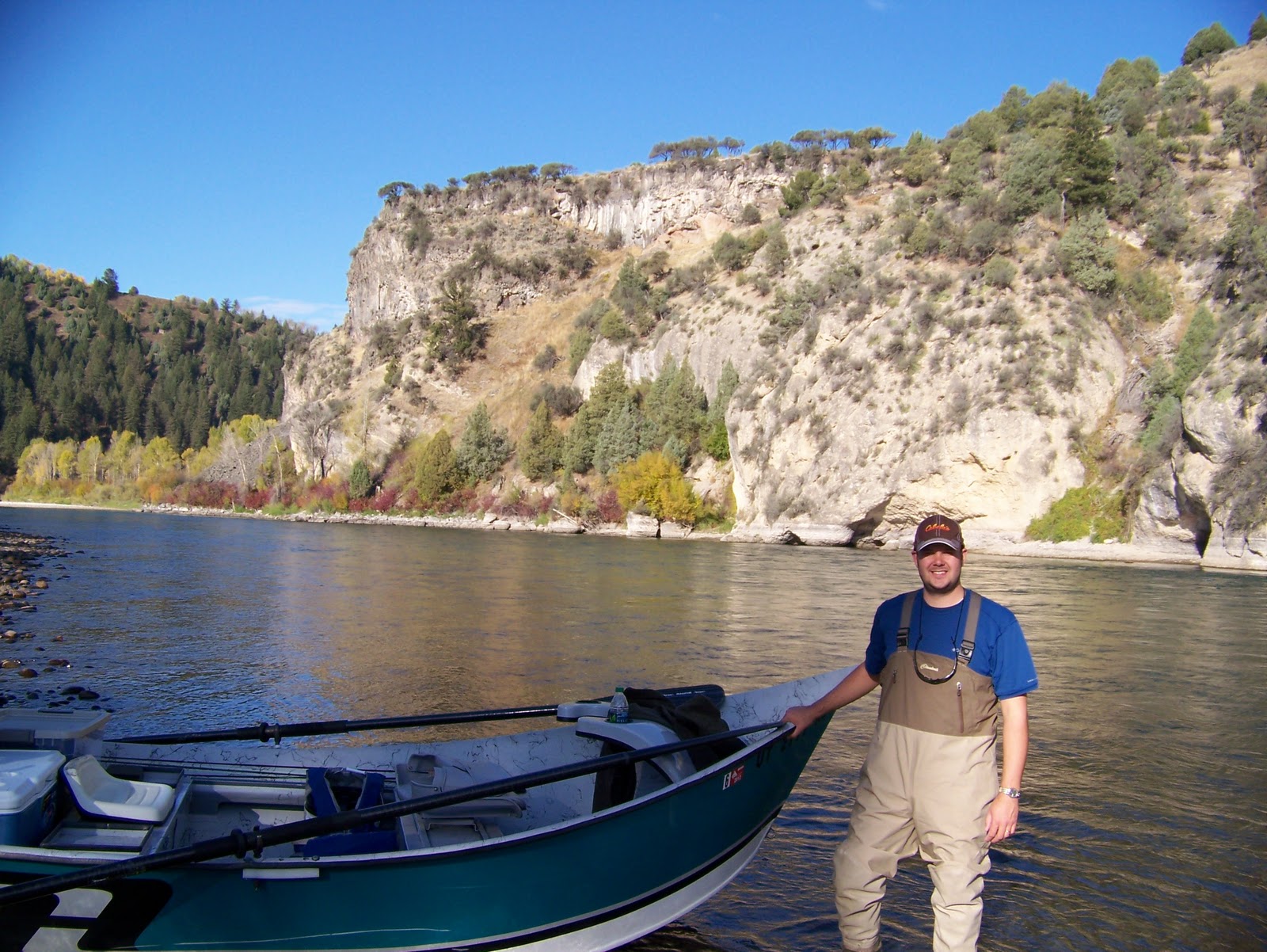
Last week my son in law Nick and I did a five day float on the South Fork of the Snake River.  A lot of planning goes into a float of this magnitude. Some of the considerations are: Rain, Freezing Temperatures, A weeks worth of food, cooking supplies, protection from raccoons or even worse – skunks, and most importantly six fly rods.

Storage Space
The first thing I did was remove the back seat of the drift boat giving more storage space.  This allowed me to store large totes and even a table top.  It also made space so I didn’t have to skimp on supplies or food trying to save space. 

Rain
To combat the rain, I had to make sure everything in the boat was prepared.  The biggest help was to get waterproof tote bins.  I found the perfect ones; clear, see-through sides with a locking top.  In these bins we could throw coats, duffle bags, food or whatever and know they wouldn’t get wet in a downpour or a splash from a wave. 

The tent and one of the self-inflating mattresses that wouldn’t fit in the tote we put in the middle seat.  The tent I had water-proofed when I bought it twenty-two years ago.  It held up quite well, however the night it rained a couple of drops did seep through the zipper right above Nicks head and happened to hit him in the eye.  One of the sleeping bags came in a dry bag and one we stuffed in a dry bag that we had brought.  We of course, brought rain coats and waders.  If it was actually raining while we were drifting, we would put a tarp over the back of the boat just to keep the rain off the supplies.

Freezing Temperatures
Since it was getting late in the year we knew it might hit freezing temperatures at night.  I had my usual sleeping bags that were fine for warm weather but I didn’t have any rated for freezing temperatures.  A trip to Cabela’s bargain bin solved this.  Jennifer and I were able to procure a Cabela’s Alaskan Guide rectangle sleeping bag rated to zero degrees and a North Face Dark Star mummy sleeping bag rated to -40.  Of course, we had coats, waders and hats for the day time.

Food
Nick and I are two growing boys so we needed plenty of food… but also didn’t want to distract from our fishing time by having to prepare food.  A cooler was another thing I had to buy for the trip.  I had a small cooler that was great for day trips or even an over-nighter, but not for a whole week.  Another trip to Cabelas solved this problem.  I bought a 5-day rated cooler.  This handled all the refrigerated items we brought.  Two blocks of ice stayed frozen the whole time. 

For breakfast we had cold cereal and milk.  Cinnamon Toast Crunch was our favorite.  We also had shredded wheat and Life Cereal.
For lunch we had sandwiches prepared the day before the trip.  These consisted of whole grain bread, pastrami, roast beef, Swiss and cheddar cheese, butter and mayonnaise.  The sandwiches were made so there was a slice of cheese immediately next to the bread so it wouldn’t get moist.  A small amount of butter and mayonnaise was spread on the inside side of the cheese.  The meat went in the middle.  Each sandwich was placed in a zip lock bag. 

Dinners were prepared after dark when the fishing was done for the day.  These consisted of various pop-top cans of stew, meat and potatoes or ravioli.  A little portable propane stove was used to warm the cans of food.  

For snacks we had Fritos, nut bars, and Butterfinger candy bars that Karen had given to Nick for his birthday.
For drinks we had fruit drinks, gator-aide and bottled water.  The bottled water lasted until the last day when we refilled the empty bottles of water with water from the 6 gallon jug we brought.

Table
For the table we brought the top of a desk which was just a plastic board and placed it on top of two of the totes.  This worked as a table for cooking as well as for eating.  For chairs we used the cooler and a bucket with a life jacket as padding.
Protection from the critters
At night we would place a tote on top of the cooler and place totes on each side with the table top on top.  This seemed to protect the food from the critters we encountered on the trip. 

The Fishing Equipment
The fly rods we would keep assembled and placed on each side of the boat in the rod holders, which handled two of them, or right on top of the rod holders.  For each of us, one rod was for nymph fishing, one for streamer fishing and one for dry fly fishing.  This way we could easily switch from one method to another without having to re-rig every time.

Darkness
We had the usual flashlights but we also had a candle lantern.  This lantern provided light while we ate dinner.  It also served as an insect repellent as it contained citronella. 

Buckets
Buckets served a couple of purposes on this trip.  One was to serve as a bailing tool.  The first night and day it rained and the boat took on some water.  Before setting off on the float the second day we used one bucket to scoop out as much water as we could.  The other served as our tool to take on nature hikes, with toilet seat and all.

Checklist
Before every trip I like to prepare a checklist.  Depending on the details of the trip, with boat or without boat, staying in a hotel or camping; I prepare a different list.  I use the list to make sure I have everything needed and prepared for the trip.  Then, after everything is loaded, I go over the list one last time checking off each item to make sure nothing is forgotten.  There is nothing worse than getting to your first campsite and finding out you forgot the matches, or something even more critical.