Wednesday, March 2, 2016

Alaskan Guide Model Tent Review (8 Person)


Description: This is an impressive all season tent.  You can tell by the rain fly that this tent will withstand bad weather.  The dome style makes this tent sturdy and it will withstand snowfall and heavy winds.  It weighs 38 pounds with the fiberglass poles (with aluminum it weighs 31 pounds).  

It isn’t a tent that you are going to take back packing.  It is a heavy duty tent.  At the same time it is not an overly heavy or huge canvas tent.  It is made from ripstop polyester.  


The dome is created by six poles, aluminum or fiberglass.   It has six sides.  It is 6 feet 8 Inches tall and 120 square feet.  It has two doors. The main entrance door has a vestibule of approximately 5 ft by 5 ft.  

The other entrance is a side/back door which can serve as a window.  It also has a mesh side window other than the two doors.  


At the top are three mesh roof vents which do not have the option of being closed.  

Since the fly goes practically to the ground there is no worry about rain getting in, however on real cold nights you may wish these vents could be closed.  On the other hand, closing these vents may contribute to condensation build up inside the tent.  All seams are tape sealed.


The tent itself is held down with 6 stakes, one on each corner.  The stakes are made of steel, 12 inches long.  

They are nice stakes; however they bend quite easily.  I have had a few bend at the top while being pounded into the ground.  The top of the stake is kind of sharp so it marks up a plastic or rubber mallet if used. 


The rainfly is huge.  It has a large vestibule in the front and goes to six inches from the ground all around.  You are going to stay dry in this tent.  In fact, I’ve had friends ask, why do you need a tent at all when you’ve got such a robust rain fly?  The rain fly uses the remainder of the approximately 22 stakes.  
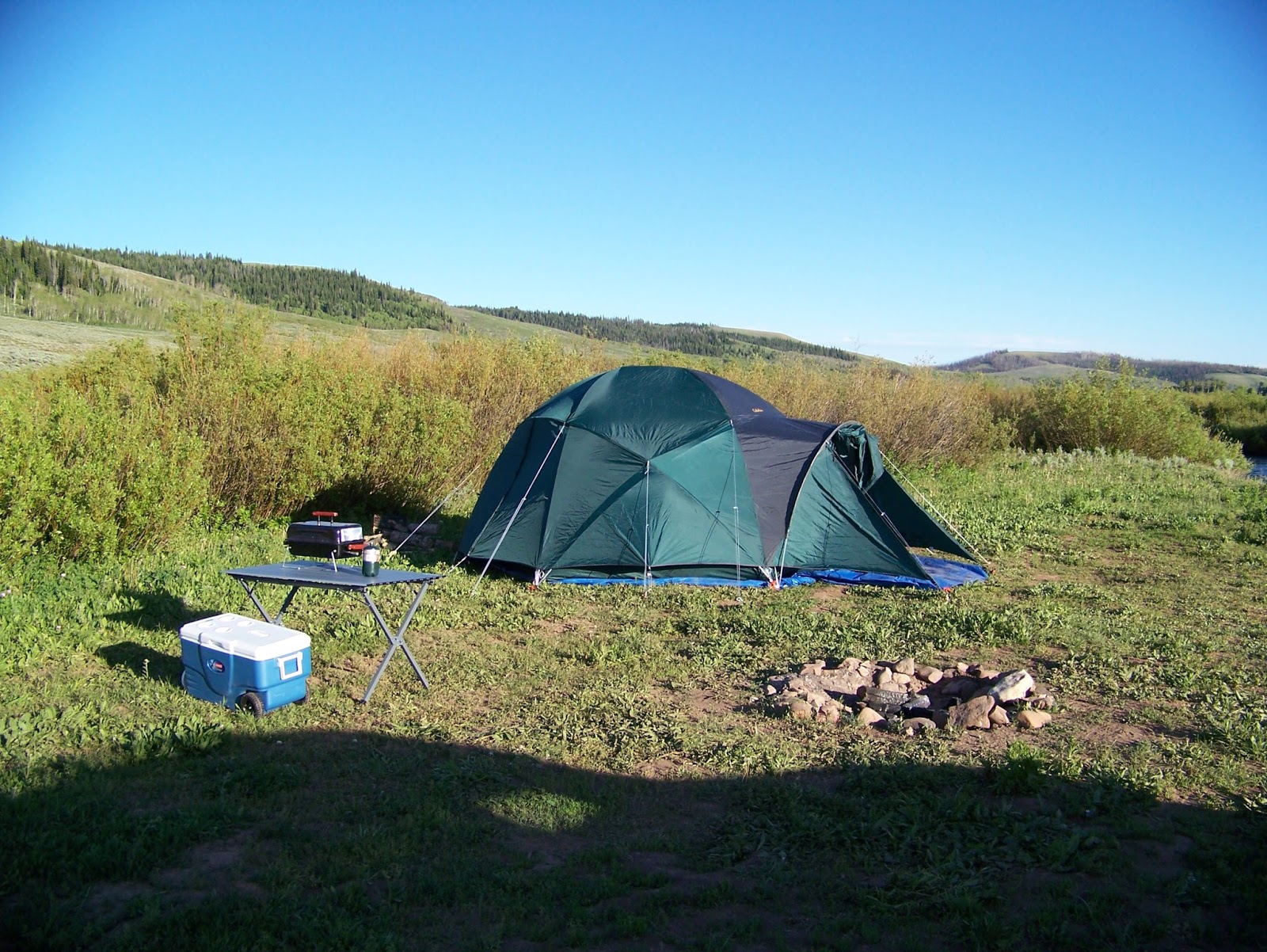
The fly is attached to the bottom of the tent with little bungee cords and then attached to the ground with 14 guy ropes and stakes.  The vestibule uses the remaining two stakes.


The tent is green and white.  The rain fly is green and gray.  There are reflector guy out loops to which the guy ropes attach. 

Set up: I like the fact that the set up instructions are sewn into the duffle bag.  I have had several other tents where the instructions were provided on paper.  

These usually get lost or ruined during the first couple uses.  The instructions for this tent will not get ruined or lost.


Floor Liner:  Cabela’s sells a real nice inside liner for this tent.  It hooks to each corner and protects the floor of the tent.  It also makes cleaning easy.  

Just unhook each corner, fold up the liner and take it outside to shake off.  You can roll it up separately or put it back in the tent and roll the tent up with it in place.


Tarp:  Cabela’s also sells a gray tarp for placing on the ground on which to pitch the tent.  This tarp is pretty much worthless, similar to the plastic from a garbage bag.  

I purchased from harbor freight a heavier duty tarp and cut it to the right shape for the bottom of the tent and vestibule. 


Vestibule:  Having the tarp big enough for the vestibule makes it so you can take your wading boots off on the tarp under the protection of the vestibule.  

The vestibule actually turns out to be quite useful.  I keep the cooler, waders to dry and camping chairs to sit on in the spacious vestibule. 


Stakes:  I mentioned the stakes earlier but I wanted to point out what I ended up doing.  The stakes provided are quality, heavy duty steel stakes.  But the tops do bend after a while, they rust and are quite heavy and bulky.  


The Army Surplus stores sell the perfect stakes.  They are aluminum and therefore lightweight, strong and they don’t rust.  They are shaped so they can stack within each other and therefore takes little space.  They are also fairly inexpensive, 1-2 dollars apiece.  There are two different sizes and colors.  

The smaller orange ones are eight inches long.  

The larger green ones are 12 inches long.  Both sizes are sufficiently big and strong enough for this tent.  There is another kind of stake also made of aluminum which is strong and won’t bend, the Coghlans stake.   


It is orange and three sided.  What I like is that it is super light.  I usually use the Army Surplus stakes for the corners and the even lighter Coghlans stakes for the other positions.


Thursday, January 28, 2016

Midas Cichlids, Turtles and Manatees in South Florida Canals


During previous trips to Miami I would notice a fish in the canals that looked like a golden bluegill.  I looked up the species and it turns out to be a Midas Cichlid.  

Peacock Bass are also in the Cichlid family but more closely resembling a bass than a bluegill.  These Midas Cichlids are real wary and tough to fool. 

They seem to sense when you are on a nearby bank and maybe they have to be since they are so easy to spot.  They haven’t ever taken the larger flies that I use for the Peacocks so on this trip I put on a small woolly bugger.  After spotting one, I stayed back a bit from the bank and cast the fly further out and stripped it in close to where it was located.  It struck.  

It put up a small fight until I hoisted it onto the bank. On shore it was calm, similar to the peacocks and allowed me to extract the fly and take pictures without a struggle. 

Later that same day, I noticed a turtle resting with its head out of the water.  Since I had a turtle actually hit my lure the day before, I brought my fly close to it.  The turtle didn’t strike the fly but the fly foul hooked the turtle in the shell and I was able to bring it to bank after an awkward struggle. 

The most surprising bit of wildlife I saw was a manatee swimming right by me in the canal.  This is on the fresh water side of the salinity stations and usually I only see them on the salt water side.  

News in the local newspaper that week was that the manatee may be taken off the endangered list soon. 


The weather this week was a bit cooler, with daytime temperatures in the low seventies and at night reaching into the sixties.  This being the case, the peacock bass were deep.  

Usually you find them hanging out in the plant and rocks near shore and you fish your streamer accordingly.  

It took me some time to figure out I needed to cast near the middle and deepest part of the canal.  

Using a sink tip line, I would let the weighted streamer sink for a few seconds before slowly stripping and teasing it in.  The fishing was slow with the peacocks being mostly sluggish but I did manage to coax a few of the mid-sized ones into striking.

Thursday, December 31, 2015

Camping in an Alaknak Tent

Last summer I took my family hiking up at Mirror Lake.  Not only was it summer, it was the middle of July.  The elevation is 1,050 ft.  It was cold and rainy.  The family brought jackets but were not prepared for this. Even us die-hard campers and fishermen were cold.  My wife let me know right then and there that she could not go camping, even in the middle of the summer, without a tent that had a heater.  Not only a heater like I use for my other tents, but a wood burning stove tent. 
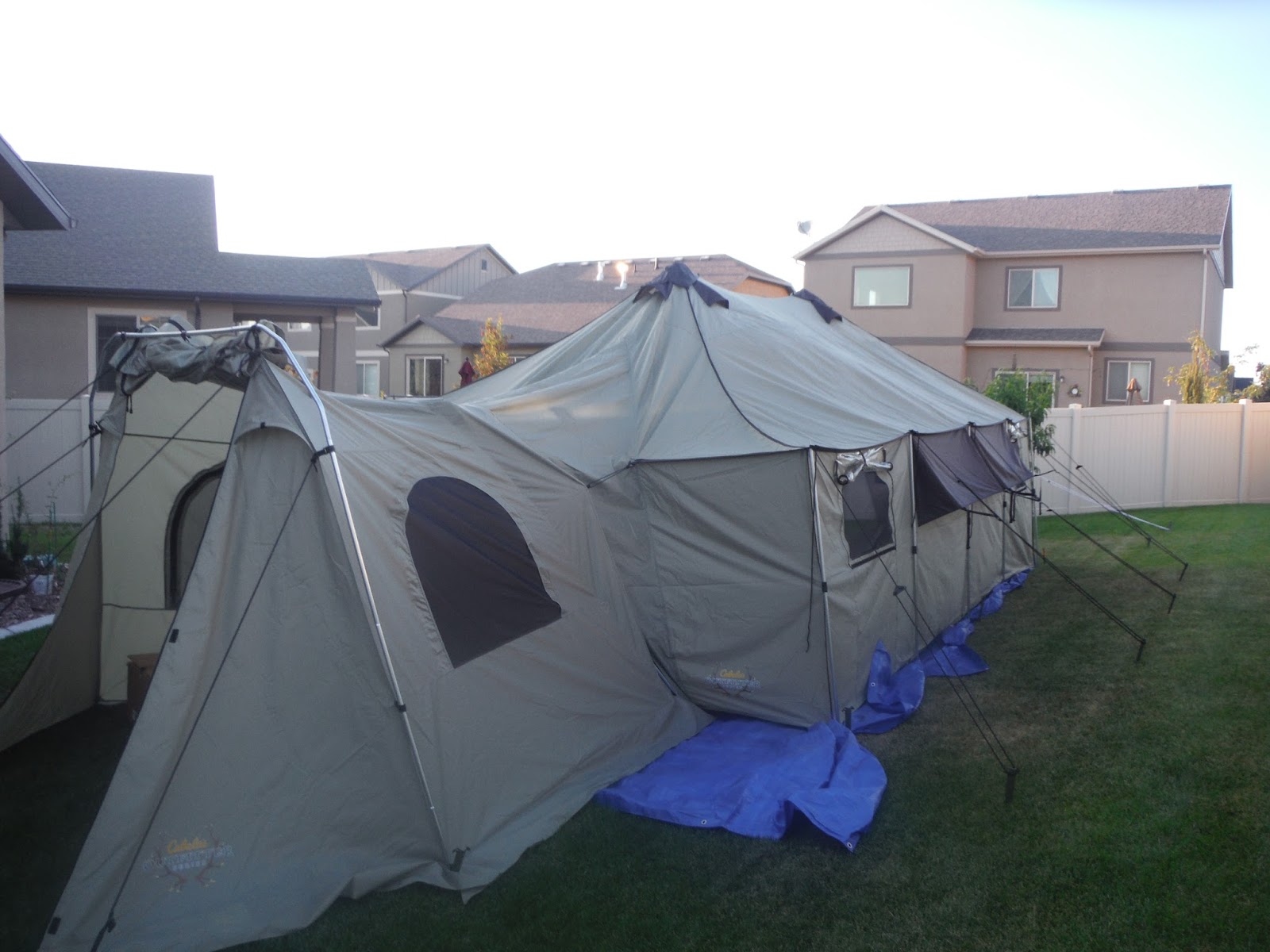
 We looked at a few that would work and ended up getting an Alaknak from Cabela’s.  It is 12 X 23 feet and has the capability of housing a wood-burning stove. 
While first setting it up in the backyard for a sleepover with my grand-son Josh, he exclaimed “This is as big as our first house”. 
Gary helped me set it up.  He said it reminded him of the tents in the Hobbit.  You approach it from the outside and it doesn’t look like much.  Then you go in and it’s humongous with all these cool features. 
Josh was able to put his various toys in all the cup holders spread throughout the tent.  There are four windows on each side. 
The vestibule itself is plenty big enough for two cots which serves well to store and protect supplies like waders and coolers.  With just the two cots, we felt like the area with the wood stove was perfect as a dining room; room enough for table, chairs and everything.  One thing I liked the most was how easy it is to set up.  Easy enough for one person, although it helps to have help.  

After the practice at setting up the tent with Gary in the backyard, I was ready to take it out camping for real; in the fall with freezing nights.  Nick called and said he was going to be in Yellowstone and could meet me for a few days on the Green River below Fontanelle. 
I invited Gary over again to help me “burn in” the stove so there wouldn’t be paint smell and smoke inside the tent the first time it was used.  We burned through a bundle of wood in 2-3 hours which served perfect for the burn in. 
Loading the SUV with all the additional camping supplies like wood and the wood burning stove along with a disassembled pontoon boat proved to be challenging but doable. 
Going straight from work, I met Nick and Alex at about 6:00 at the Weeping Rock campground.  We found a site with a tent pad big enough for the Alaknak and had it set up by 7:00, right when it got dark.  The evening was gorgeous and we set up a campfire for Alex to fix us bratwursts for dinner.  With the clear skies we took a few moments now and then to look at the constellations.  
 We set up the three cots, table and stove.  Since it was so warm that evening we didn’t start the fire in the stove, although it was cold the next morning.

Inside the tent we used the propane heater to take the chill off and used the propane stove to boil water for the oatmeal.  The next evening we did start the fire in the stove, even though again it was a warm evening.  
The stove did a wonderful job keeping the tent nice and toasty.  I checked on the spark arrestor a couple of times and it did the job.  The roof protector also worked well and there wasn’t any concern about the safety of the tent.  
We were able to cook dinner, cans of stew, right on the stove.  It took about the same amount of time to get the stew boiling as did the propane stove. The tent was nice and warm in the morning which made it so much easier to get up and fix breakfast.  The only downside was that the fire needed attention quite often during the night to keep it going.  We boiled water right on the stove for the oatmeal.  The following evening, since it was warm again, we didn’t keep the fire going all night but rather, got the fire ready to start so that in the morning, before getting up, someone could easily start the fire, go back to bed and the tent would be warm by the time we got up.