Monday, January 14, 2013

Catching Five Species of Fish on the Green River in Wyoming

I couldn’t resist getting out one more time with another nice November day.  The forecast said it would be in the high forties in Kemmerer. 

I mentioned this to Ron and we made plans to hit the Green below Fontenelle again. 

I drove down to the bank of the river at weeping rocks similar to what our “friend” did on our previous trip.  

This time, we did have the river to ourselves.   

We rigged up with prince nymphs, glo-bugs and streamers.   

We caught several of the usual mid-size rainbows that we usually catch in this section and a lot of White Fish.   

Then a cast on the far side of the river produced a slightly larger fish.  At first I thought it was just a larger rainbow and thought nothing of it.  

As I brought it to the net however, I could tell it was not a rainbow, but a Lake Trout.  

I didn’t expect that.  This added excitement to the day.  Although this Lake Trout only measured 19 inches which is small for a Lake Trout, it let us know that there was a possibility larger Lake Trout had swam upstream from Flaming Gorge to spawn.

Moving downstream a bit to the deeper, slower water seemed to produce mostly White Fish, which also seemed happy with either prince nymphs or glo-bugs.

There were a couple other stretches of the river I wanted to try.  We packed up and went to the first of these, in the deeper water just past the Slate Rock Campground.  

Here we managed to catch two more species.   

Ron caught a Cutthroat and I caught a Brown.   

Ron also caught a Lake Trout in this stretch.  That makes five species that we caught on this trip: Rainbow, White Fish, Cutthroat, Brown and Lake Trout.

We still had one more stretch to try; the stretch where I hooked into that monster brown at the end of the day on the trip with the guide.  This stretch is a pretty consistent depth, about mid-thigh deep.  There was ice along the edge that we had to break through to get into the water to wade.  I hiked upstream to the bend where there were some riffles but didn’t have any luck.  I also hiked downstream to the next bend where there were more pronounce riffles but also nothing.  I also fished the consistent depth water in between but still no strikes.  

Ron however, caught the largest fish of the trip in this stretch; a 19 and three quarters inch, thick bodied rainbow.

Wednesday, January 2, 2013

The Kokanee Salmon's Spawning Migration Up The Green River

Last October when Nick and I were fishing the Green, the first thing we noticed was all the dead fish in the river.  As I approached the river, indeed it looked like a Kokanee Salmon grave yard; all these decaying fish lying on the bottom of the river. 

I attended my 30 year high school reunion a couple of years ago and an old friend of mine came up to me and said “you know what I remember about you?  That oral report you gave on salmon.”  I had forgotten about that.  Even now, I am remembered for my interest in fish.

The Kokanee Salmon from Flaming Gorge do their spawn run in the fall and swim up to spawn in the river in which they were hatched.  Since the Fontenelle Dam on the Green River would stop any further migration on this river, the majority end up spawning in the few miles of river below the dam.  In fact, the river is closed to fishing in the fall the first mile below the dam. 
 
These adult salmon which are three to five years old average 15 to 18 inches long.  They turn bright red on their bodies and dark green on their heads.  The bright red spawning salmon are way past the point where they would be good eating.  The male's jaws become deformed with a pronounced kype and they grow humped backs. 
 
After spawning, the kokanee soon die, thus completing the salmon life cycle or as we learn in the movie Lion King, the circle of life.  The dead salmon not only provide food for predators and scavengers, but as they decompose, the water is fertilized increasing plankton growth which the newly hatched fry will eat.  The fish are so interesting, somewhat grotesque looking and such a unique experience to see that I thought it would be worth mentioning and sharing a few pictures.


Friday, December 14, 2012

A Friend on the River


Going fishing is all about getting away from the city, crowds, work and worries.  When you get to the stream it is nice to find you’ve got the whole river to yourself.  Often times if someone is already working a particular stretch, you can drive a ways upstream or downstream so you don’t bother this fisherman’s solitude.  That’s in an ideal world.  On certain rivers, for example the Provo or Weber rivers near Salt Lake City, there are often cars parked at each turn out or access point near the river.  In this case, you do your best to fish upstream or downstream not disturbing those already on the river. 

On the other hand, those already on the river probably fish the river quite regularly.  They have also been fishing that particular day and would already have a clue what is working.  Any information you glean would be valuable and give you a good start for the day.  I have found that although fishermen are a quiet, solitary lot, they are also friendly, helpful and like to either share their knowledge or brag about their success.  Either way, you’ll learn something.

After Ron and I finished fishing the Ham’s Fork, we headed east over to the Green River.  As we arrived, we had all the above situations occur. 
 
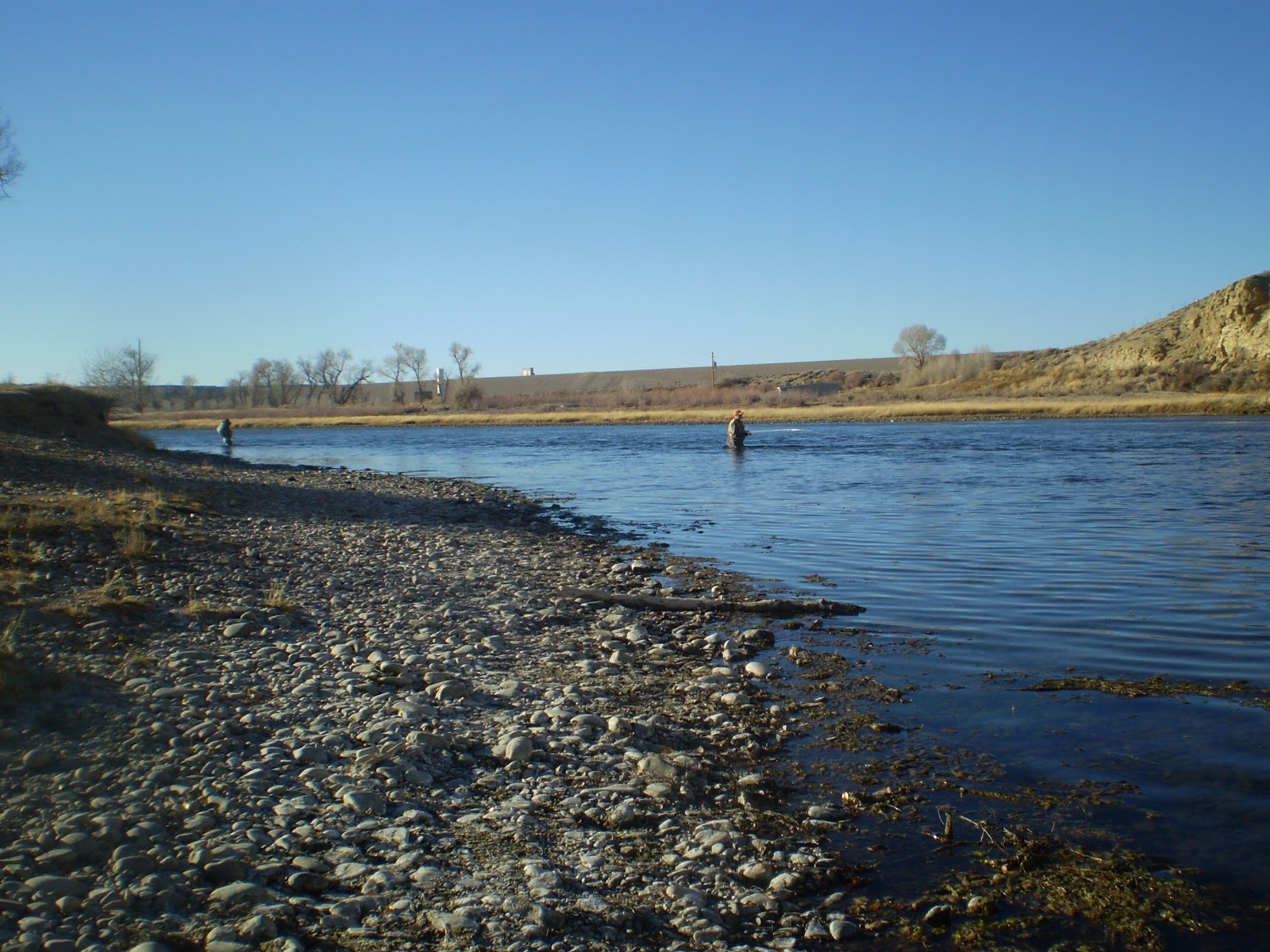
It was exciting to find we were the only ones on that stretch of river.  We had the river to ourselves.  I stopped at the campsite restroom real quick before heading down to the river.  Wouldn’t you know it, a truck drove right down to the bank right where we were going to fish.   There is a drop off in the middle of the river at this particular spot where the fish line up to feed.  They have the current in the shallow water bringing food morsels by while they hang out in the deeper water without having to fight the strong current.

We started fishing just upstream from where this other gentleman was fishing.  After a while it was obvious that he was catching quite a few while Ron and I were not.  I walked over and started talking to him.  Just like I mentioned above about other fisherman, he offered what he was using and his technique to catch the fish.  He said he was using a prince nymph and glo bug although all the fish he had just caught were on the prince nymph. 
 
Prince nymphs, btw, are made with a peacock hearl body, soft brown or black hackle and white turkey or goose biots for the wings laid flat at the thorax.  He even offered to give me one if I didn’t have any.  Other than that, his rig seemed similar to ours, a small white strike indicator (Thingamabobber) about 7 feet above the flies, one or two BB size split shot for weight fished dead drift.  Ron and I of course, commenced to tie on prince nymphs and shortly thereafter were able to catch a few rainbows. 
 
One of these even approached 20 inches.  Prince nymphs were something I would have never thought of to try.  In fact, my prince nymph collection was still at home with my other infrequently used flies.  Luckily Ron had a few.  With the help from this friend on the river, we were able to have success on the river this day and learn something that I will be able to use on future trips.

Monday, December 3, 2012

Streamer Fishing the Ham’s Fork


I like to keep an eye on the weather in November; it can have some pretty nice days.  In fact, my daughter Madison mowed the lawn on Thanksgiving Day.  As most of my readers know by now, fall is my favorite season for fishing.  A couple of warm November days can provide the perfect trip.  Ron from my work’s Toxicology lab had been asking how to get to some of the places I had been fishing this year so I invited him to join me.  My intent was to fish the private section of the Ham’s Fork that Nick and I had recently fished.  I was disappointed as I got to the turn off to access the property when there was a sign that said there were no trespassing permits given between November 1 and May 1.  Luckily there is a public access trail and bridge over the fence just down the road.  I had hiked along the upper stretch of this public water on my last visit to Ham’s Fork.  It didn’t look like it had much structure or riffles as the upper section, but that there were some deep pools.  I had always used small nymphs on this river and had had good luck, even with the many rainbows that were over 20 inches.  This late in the year I was curious to see how a streamer would work and rigged my rod accordingly, with a black wooly bugger.  Ron set up his rod for nymph fishing, tying on a bead head pheasant tail.  Since the morning temperature was still in the thirties, we wore our sweatshirts.  By the time we had hiked to the river, however, we were both sweating. 

Ron began fishing right were we hit the water, near the fence.  I headed downstream.  Before I had time to get to another good looking stretch, Ron had hooked one. This was a good start for trying different water.  I set my pole down and ran back just in time to see it released.  He also netted a second rainbow from the same hole.

As I worked my way downstream, I saw a few fish which I must have spooked because they were bolting downstream.  I finally reached a larger pool deep enough for the fish to hide and far enough across that I could barely hit the other side with the streamer. 
 
On one of my first casts, I saw a fish chasing the fly as I quickly stripped it in.  I slowed down my retrieve and it hit.  As soon as it felt the fly it bolted into the deep water.  I let it take out line until it slowed down.  I then slowly reeled in line and brought it closer.  It made a couple more short runs before I was able to bring it to the net.  What a beauty, a 23 inch male; pretty good for my first fish. 
 
I hooked this trout at the start of the pool so I continued to work my way down the pool.  I hooked a second smaller fish a couple of casts later.  I tried to coax it in a little too fast and it came of just as I was reaching out the net. 
 
Another rainbow did manage to come to net.  This one was peculiar because it had no spots except for near the tail.

I hiked back upstream to meet up with Ron and tell him about the deep hole he needs to try. 
 
Ron started nymph fishing at the top of the pool while I continued downstream to the middle of the pool. 
 
Shortly later Ron landed a couple more rainbows on a bead head pheasant tail.

 I could barely hit the opposite side of the river across this pool double hauling with the streamer.  A couple of casts later, I hit the shore with the streamer and quickly pulled it into the river.  Luckily it didn’t get snagged on the weeds and within a couple of strips I had a strike.  This fish took off right away into the deep.  I could tell it was a big one.  I got it close to shore a couple of times but each time it got close it would take out more line.  Ron came over with his net and waited for me to calm the fish down. 
 
I slid the fish over to where Ron was standing with the net allowing him to scoop it up.  In fact, he had to make sure he got it in head first because it was larger than the net.  It wasn’t as large as the first rainbow, but fought a lot harder.  The fish ended up measuring 21 inches and looked a bit unique with its elongated spots, not typical for a rainbow. 
 
At this point I was at a part of the pool where the water had overflowed its banks and there was quite a bit of sediment.  It was easy enough to walk on, but as one stands in the same spot for a moment, for example to cast and strip in a streamer, it would suck you right in.   I started trying to get my feet loose.  As I started pulling up my right foot, my left would sink further.  After going back and forth like this for a few minutes and getting deeper and deeper in the mud, I finally yelled to Ron and had him grab a branch from a nearby bush to help pull me out.  A few minutes later I was out and back on sturdy land.
 

Monday, November 19, 2012

Last Day, Back to Weeping Rocks on the Green River


Since it was the last day of the trip; Friday already, Nick and I had to make a plan so we would leave on time.  We needed to be home by 5:00 for the big birthday celebration for the four family members with birthdays in October.  This meant we needed to leave by 1:00 so we would have time to stop in Evanston for a Chinese buffet Late-lunch.  There is also the tent to put away and the car to load. We better give ourselves two hours for this, especially if we want to eat a sandwich while we’re at it.  So we better finish fishing by 11:00. 

Since our guide, Ryan, seemed to have so much faith in the fishing at Weeping Rocks, we decided to fish there.  This seemed to be a stretch of the river that could be easily fished by wading.  Plus it is only five miles away from our camp.  Except after we had travelled ten miles, I asked Nick if we had passed the turn off, oops. 

At Weeping Rocks Campground, we parked in one of the closest camping spots to the river and we were the first ones there.  Shortly after we arrived, three rigs with drift boats pulled up.  This group, however, didn’t seem too anxious to get going and didn’t launch until Nick and I were leaving.

Nick rigged up similar to how the guide had us rig, which is also similar to how we rigged up for the North Platte - a large red midge imitation and a red San Juan Worm.  Although the first fish was somewhat small, Nick consistently caught rainbows during our brief stay.


Earlier in the week I saw a couple of veteran fly fishermen fishing in the evening at the bend in front of our tent.  They would wade out from shore five to 10 feet in water about knee deep and as they waded downstream, would cast straight out towards the middle of the river.  Without stripping the line in they would let the current take the fly downstream until it had drifted directly below them.  They would take a couple steps downstream and make another cast.

This seemed like a good technique.  I put on a bullet head wooly bugger, brown with yellow rubber legs.  I waded in about knee deep and with a double haul, cast straight out as far as I could, perpendicular to the bank.  I allowed the current to take the fly downstream on a tight line.  When the fly was straight down stream, I would strip in a few feet of the line and then double haul another cast out to the middle of the river. 
 
Doing this, I would fish downstream through what looked like the most productive stretch of river.  As I got to the end of this stretch I had a strike.  The strike on a streamer is so definite it is sure to start the adrenaline running.  This was a hard fighting fish. After a few good runs, I ended up landing the large rainbow, a good reward for an hour of chucking a streamer.